
VIN Cloning in Canada: What Every Dealer Needs to Know in 2026
Theft numbers are down. Enforcement is working. Ontario saw a 22% drop in vehicle theft in 2025 — and that is genuinely good news.
But here is the part that does not make the headlines: the vehicles already re-VINed before the crackdown did not disappear. They are still moving through auctions, trade-ins, and private sales right now. And most of them will pass a standard history check.
This guide covers how VIN cloning works, why your current checks miss it, and the practical two-minute process your appraisal team should be running on every unit.
Key takeaways (60 seconds)
- VIN cloning (re-VINing) gives a stolen vehicle the identity of a legitimate exported one — standard history reports and CPIC checks will not flag it.
- Over 372,000 vehicles on Canadian roads may have a cloned VIN.
- Ontario's vehicle recovery rate in 2025 was 51% — roughly half of all stolen vehicles in the province were never recovered, meaning many have been re-VINed and re-entered the market.
- Two checks catch what standard reports miss: an OBD2 scanner check (free) and a VINShield export check ($14.95).
- If police seize a re-VINed vehicle from your lot — compensation is $0.
What Is VIN Cloning?
Every vehicle has a unique Vehicle Identification Number (VIN) — the car's fingerprint. In a VIN cloning scheme (also called VIN duping or re-VINing), criminals:
- Steal a vehicle
- Copy the VIN from a similar, legitimate vehicle — one that has been exported out of Canada
- Swap the identity onto the stolen unit — replacing the VIN plate, door jamb sticker, and all paperwork
- Sell the cloned vehicle through an auction, trade-in, or via private sale
Because the VIN belongs to a real, legitimate vehicle, it decodes normally. A standard history report comes back clean. The vehicle looks completely fine on paper — which is exactly why the scheme works.
Related: What Is VIN Cloning (VIN Duping) — And How to Protect Yourself
How Big Is the Problem in 2026?
CARFAX Canada estimates more than 372,000 vehicles on Canadian roads may carry fraudulent VINs. One in five Canadians reports that they or someone they know has been directly affected by vehicle fraud and theft.
The Équité Association's 2025 Auto Theft Trend Report, published in February 2026, confirmed an 18% national year-over-year decrease in vehicle theft. Encouraging — but the same report notes:
- Ontario's vehicle recovery rate was just 51% in 2025 — roughly half of all stolen vehicles in the province were never recovered, likely exported or re-VINed
- Alberta's recovery rate has declined year-over-year and now sits at 71% — the province continues to be a feeder market for re-VINed vehicle registration
- Vehicle finance fraud at the ports of Montreal and Halifax increased 72% year-over-year — organized criminal networks are adapting, not retreating
The raw theft numbers are improving. The fraud infrastructure those thefts fed is still very much active.
According to the Insurance Bureau of Canada, auto theft claims costs in Ontario increased 524% between 2018 and 2023, surpassing $1 billion for the first time. Insurance losses over the past decade have increased 371% nationally.
The Most Targeted Vehicles
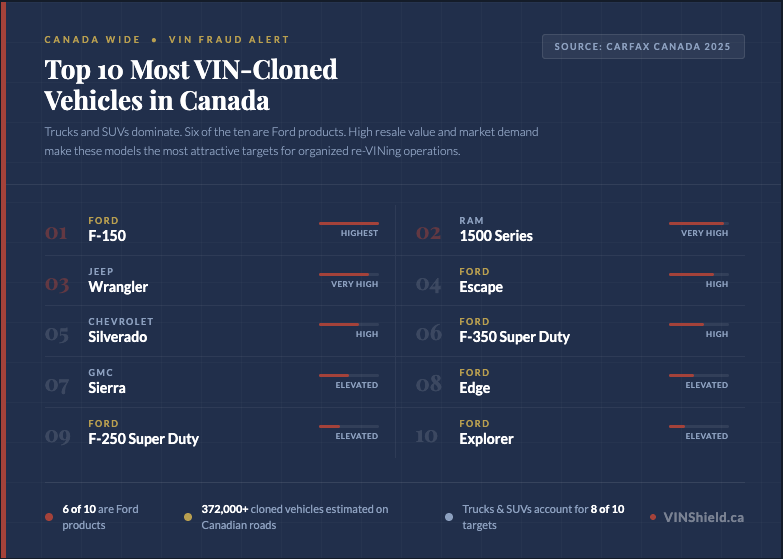
Not all vehicles carry equal risk. CARFAX Canada's data on the top 10 most VIN-cloned vehicles in Canada is dominated by trucks and SUVs:
- Ford F-150
- RAM 1500 Series
- Jeep Wrangler
- Ford Escape
- Chevrolet Silverado
- Ford F-350 Super Duty
- GMC Sierra
- Ford Edge
- Ford F-250 Super Duty
- Ford Explorer
Six of the top ten are Ford products. If your dealership regularly handles F-Series trucks, RAM 1500s, or Jeep Wranglers on trade or at auction, the risk profile of your appraisal process is higher than average.
How the Export → Clone Pipeline Works
Understanding the mechanics is the fastest way to understand why standard checks miss it.
1) A clean vehicle is exported
A legitimate vehicle is exported out of Canada — often through the Port of Montreal, Port of Halifax, or via a land border crossing. Its VIN is now attached to a vehicle that has physically left the country and no longer appears on any active domestic registry.
2) The VIN is cloned onto a stolen domestic unit
That exported VIN is transferred onto a stolen vehicle still inside Canada. The physical VIN plate is replaced, the door jamb sticker is swapped, and paperwork is forged. The stolen vehicle now carries the identity of a legitimate vehicle that was never reported stolen — because it wasn't stolen. It was exported.
3) The re-VINed vehicle enters the market
The cloned vehicle moves through auction lanes, trade-in channels, or private sales. It arrives in your appraisal bay with a history report showing no accidents, no theft flags, and a clean title. Everything looks normal.
This is the moment where a standard check fails — and where the right checks protect you.
Why Standard Checks Won't Catch This
CPIC (Canadian Police Information Centre)
A CPIC (Canadian Police Information Centre) check looks up whether a VIN has been reported stolen. A re-VINed vehicle will not appear — because the VIN it is wearing was never reported stolen. It belongs to a legitimate vehicle that was exported. There is nothing on CPIC to flag.
Standard history reports
A vehicle history report checks the history associated with that VIN number. If the VIN belongs to a clean, legitimate vehicle — which it does in a cloning scheme — the report comes back clean. The report cannot tell you whether the physical vehicle in front of you is the same vehicle the VIN was originally issued to.
Both tools are valuable. Neither was built to catch this specific fraud pattern.
The Two Checks That Actually Catch It
1) OBD2 scan (free with your scanner)
Plug an OBD2 scanner into the vehicle's diagnostic port and pull the VIN directly from the vehicle's computer. Compare that VIN against the dash plate, door jamb sticker, and all ownership paperwork.
A re-VIN job will replace the physical plates. Reprogramming every electronic module in a modern vehicle is significantly more difficult — most criminal operations do not bother. The result is a discrepancy between the paperwork VIN and the modules VIN. That discrepancy is your signal to stop the deal immediately.
2) VINShield export check ($14.95, no subscription)
VINShield.ca tracks 2.5 million+ exported Canadian VINs dating back to January 2014, covering 195 destination countries. Run the VIN and you get an instant answer to one question: has this VIN been exported from Canada?
If the answer is yes — and the vehicle is being presented as a clean local unit — you have a mismatch that no standard history report would have surfaced.
View a sample VINShield export report →
VIN Cloning Protection Checklist — 7 Steps
Use this on every trade-in or auction unit.
1) Match the VIN in multiple physical locations
The dash plate, door jamb sticker, engine block stamp, and all ownership paperwork must match exactly. If any VIN is missing, looks tampered with, or does not match — walk away.
2) Confirm make, model, year, and colour
Cross-reference all details against the registration document. A mismatch in any detail — even colour — is a red flag that should not be ignored.
Helpful reference: RCMP tips for buying a pre-owned vehicle
3) Run an OBD2 scanner check
Pull the VIN from the vehicle's computer and compare it against all physical VIN locations. A re-VINed vehicle will almost always show a discrepancy here.
4) Run a CPIC check
Confirms whether the VIN has been reported stolen to police services. Run it at cpic-cipc.ca. If the result indicate stolen and never recovered — stop the deal immediately and contact local police.
5) Run a VINShield export check
Confirm whether the VIN has been exported from Canada. If it has — and the vehicle is being presented as a local unit — that mismatch is your red flag. $14.95 at VINShield.ca. No subscription required.
6) Inspect body lines, panel gaps, and paint
Uneven panel gaps, mismatched paint shades, unusual hardware, or evidence of VIN plate removal are physical warning signs. A professional re-VIN job focuses on paperwork — the physical vehicle often shows the truth on closer inspection.
7) Trust your instincts
A story that does not add up, a seller who resists basic questions, or a price that is too good for the unit are reasons to slow down. Walk away if something feels wrong.
What Happens If You Get It Wrong
When police identify and seize a re-VINed vehicle, compensation to the dealer is $0. The unit is gone. Insurance coverage is denied. Depending on the timeline, you may also face legal exposure to any customer who purchased the vehicle from you.
At $14.95 against a $40,000+ unit, a VINShield check is the easiest risk management decision on your desk.
FAQ: VIN Cloning for Dealers
Can a cloned vehicle pass a standard history report or CPIC check? Yes. A cloned VIN decodes correctly and returns a clean history because it belongs to a real, legitimate vehicle — just not the one in front of you.
What is the difference between VIN cloning, VIN duping, and re-VINing? They are used interchangeably. All three describe the same fraud: replacing a vehicle's identity with a VIN copied from a different legitimate vehicle.
Which vehicles are most at risk of VIN cloning in Canada? Pickup trucks and SUVs dominate the list. The Ford F-150, RAM 1500, and Jeep Wrangler are the top three most VIN-cloned vehicles in Canada according to CARFAX Canada.
Does the CPIC check confirm a vehicle is safe to buy? CPIC shows whether a VIN has been reported stolen — but a re-VINed vehicle will not appear because the VIN it is wearing was never reported stolen. CPIC should be one check in a broader process, not the only one.
Why does export history help detect VIN cloning? The export step is the first step in the pipeline. If a VIN has export history — but the vehicle in front of you is being presented as a clean local unit — that mismatch is the clearest signal a VIN clone check can surface.
What should I do if I suspect a vehicle is re-VINed? Do not proceed with the purchase. Document what you can safely (listing details, VIN, messages). Contact local police if appropriate. You can also submit an anonymous tip through Crime Stoppers or call 1-800-222-TIPS (8477).
Final Takeaway
Theft numbers are improving — but the vehicles already in circulation before the crackdown are still out there. A standard history report was not built to catch this. A CPIC check was not built to catch this.
Two checks — one free, one $14.95 — will catch it.
Run a VINShield export check at VINShield.ca before your next high-value appraisal.
Related reading:
- What Is VIN Cloning (VIN Duping) — And How to Protect Yourself
- How to Protect Yourself from Purchasing a Stolen Vehicle
- What Is Grey Market Exporting of Vehicles — And Is It Legal?
- What Is Parallel Exporting / Importing of Vehicles — And Is It Legal?
Sources: CARFAX Canada · Équité Association 2025 Auto Theft Trend Report · Insurance Bureau of Canada · Globe and Mail · CBC News